*** NEW ARTICLE ON THE BLOG 07.02.2026: WHITE-CRESTED COCKATOO - THE RAREST OF THE LARGE “WHITE” COCKATOOS IN NATURE ***

Read now

WELCOME TO

BIRDKEEPER.DK


It is recommended to read the longer articles from a PC, not from a mobile phone

NEW ON BIRDKEEPER.DK FROM THURSDAY, 18 DECEMBER 2025:

BIRDKEEPER.DK … “A NEW KID ON THE BLOG”

Birdkeeper.dk has now been expanded with a blog. The blog serves as a more dynamic complement to the website’s species articles, thematic features, and in-depth articles, providing space for shorter, ongoing posts about the keeping, care, and breeding of selected parrot species, as well as other relevant topics within aviculture.


The tone of the blog posts is generally less formal, while remaining firmly grounded in professional knowledge. Here, readers will find new posts as well as posts previously shared on Facebook, often presented in a revised and sometimes more detailed version. These may also be supplemented with new photographs or video clips that have not necessarily been shown before.


In addition, the blog allows images to be displayed in a larger format than is possible on Facebook.

The blog is structured around several general topics, making it easy for readers to find content that matches their interests. Whereas the main website primarily contains static, basic and detailed information about species and selected topics, the blog offers dated, current posts focusing on practical experience, observations, breeding progress, and seasonal aspects, etc.


Both the website and the blog will be updated when time and inspiration allow, always with an emphasis on quality, professionalism, and respect for the species involved.


You can access the blog by clicking "Blog" in the "Menu bar" above.


Enjoy the reading!


Jørgen Petersen

Editor

ARTICLE:


ONLY TWO RECOGNISED SCARLET MACAW SUBSPECIES - WHAT SCIENCE ACTUALLY SHOWS


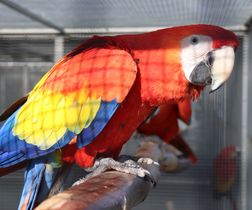
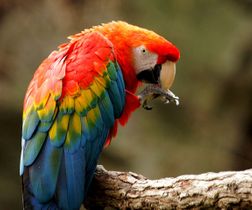
A recent, comprehensive genetic study has definitively settled a debate that has caused confusion among aviculturists for years: How many subspecies of the Scarlet Macaw actually exist? Despite claims from individual aviculturists and various images circulating on social media, scientific literature continues to document only two subspecies:


  • Southern Scarlet Macaw - Ara macao macao
  • Northern Scarlet Macaw - Ara macao cyanopterus (scientifically recognized in 1994 based on extensive morphological data).


The newest genetic study confirms with great clarity that these two forms are the only ones supported by scientific evidence. Researchers examined both live birds and museum specimens from the species’ entire natural distribution range in Central America and northern South America, including Nicaragua, the region from which some aviculturists claim unusually large birds originate, allegedly characterised by maroon-coloured underwing coverts and a longer, broader tail.


In short: There is no third subspecies.

Read the article on the genetic study by pushing the button above.


Conceived/Updated: 10.12.2025 / 10.12.2025


IT IS NOT ALLOWED TO COPY PHOTOS OR TEXT FROM THIS WEBSITE WITHOUT PRIOR WRITTEN ACCEPTANCE!

CHRONICLE:


WHEN ANECDOTES AND OTHER UNCONFIR-MED INFORMATION BECOME “NEW” SPECIES/ SUBSPECIES - A CHALLENGE FOR AVICULTURE


When personal impressions, social-media photos and unverified claims are elevated to the status of “new” species, subspecies or “local forms”, they create noise and confusion within aviculture. In an age where opinions spread faster than facts, the role of serious aviculturist is more crucial than ever. A science-based approach - grounded in research, data, genetic analyses and taxonomy - provides clarity, stability and a shared foundation for responsible breeding, where the concept of species variance is of great importance.


This chronicle explores how a scientifically oriented aviculturist can navigate among the many anecdotes circulating in groups and on social media, and why variations between individual birds fairly seldom constitute evidence of new subspecies. By choosing documented knowledge over personal interpretations, we strengthen aviculture as a whole and create an environment where facts carry more weight than stories. This is the approach that truly moves our hobby forward.


When science in some cases even merges previously recognized subspecies, it simply highlights the importance of robust data. For aviculturists and breeders, this provides a more realistic basis for our work and helps us focus on what can be documented rather than what merely sounds convincing on Facebook.


Conceived/Updated: 12.12.2025 / 12.12.2025


IT IS NOT ALLOWED TO COPY PHOTOS OR TEXT FROM THIS WEBSITE WITHOUT PRIOR WRITTEN ACCEPTANCE!

Do you want to start seeing a nearly 5 minutes long slideshow-presentation of www.birdkeeper.dk?

... then press the play button in the lower left corner of the PowerPoint video presentation (with sound). If you want to see the presentation in full screen, push the "enlarge screen" icon in the lower right corner.

Dear reader,


Some time ago, my website, www.birdkeeper.dk, was migrated to a new technical platform when my long-standing supplier of website solutions was acquired by a competitor. I have therefore had to spend quite a bit of time getting to know the new software. I am now so far that I can start using many of the new functionalities, which is contributing to the website gradually appearing more up-to-date.


The website went live for the first time on 23rd December 2009, and over the years the website has gained an ever-increasing number of readers from abroad. This meant that in January 2019 I tried to publish my first article in English here on the website, which has been received extremely positively by readers all over Europe and on certain other continents. I have therefore chosen to "go international" so that www.birdkeeper.dk in future will become an international website for parrot enthusiasts with notes, articles, etc. written in English. This transition from Danish to English is happening successively, as it means that a large part of already published articles must be translated into English. However, this work has begun, and this version of the new website represents "www.birdkeeper.dk version 2.0".


Happy reading!


Jorgen Petersen
Editor

TILBUD TIL DE DANSKE FUGLEFORENINGER (tryk på Play-knappen)

Are you by chance interested in keeping and breeding Eclectus Parrots?

Overview over articles on the Eclectus genus

Click on the button to proceed to the 14 articles


1st April 2024:


Now at www.birdkeeper.dk you can find a total of 14 articles about the impressive and extremely fascinating Eclectus Parrots, their life and status in the wild, behaviour, accommodation, breeding and not least how to care and feed them in human care as well as descriptions of the many different subspecies including a guide to subspecies determination.


Enjoy your reading!


Jorgen Petersen

Editor


PS.

This series of articles on Eclectus Parrots is intended for serious aviculturists keeping Eclectus Parrots as aviary birds with the aim of species conservation breeding, not for people who keep “Eccies” as single pet birds.

Most recently published in-depth article (on taxonomy and genetics):

About the Blue-naped Parrot (Tanygnathus lucionensis) - A story about determining the right subspecies".


This article mainly sheds light on taxonomic and morphological aspects ofTanygnathus lucionensis. In addition, a short introduction to the entire genus and toTanygnathus lucionensisin wildlife are given and it furthermore tells a story of how things can go wrong when acquiring new birds, but above all, how “I got by with a little help from a friend” and found out which kind of subspecies I keep in my aviaries.


Please note that the article does not deal with the keeping, feeding and breeding of the species in human care.


The article is aimed at nerds/specialists and has been created with significant contributions from Mr. Mehd Halaouate, a very experienced aviculturist and former manager of the World Parrot Trust and highly respected specialist within Indonesia’s wild birdlife.As another exception for articles published onwww.birdkeeper.dkthis article is written in English so that aviculturists outside Denmark who are interested in this genus, also have the opportunity to benefit from the article.


Happy reading!


Jorgen Petersen

Editor

Behind www.birdkeeper.dk:

Theme articles:
Cronicles, other articles and notes:
NB.!


Please be aware that www.birdkeeper.dk  has many other notes, articles, etc., which can be read on some of the many other pages that do not appear on this front page.


Therefore, try to "surf" around the various tabs with corresponding subtabs that appear at the top of the website.


The articles that have not yet been translated from Danish to English will be successively translated when the time and desire opens up the opportunity to do so.


Happy hunting for new knowledge!

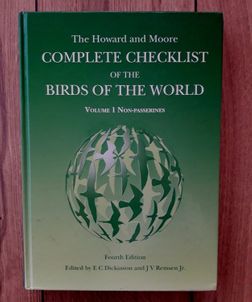
Mini portraits and articles - Parrot species from Africa
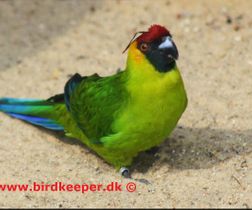
Mini portraits and articles - Parrot species from Asia and Oceania
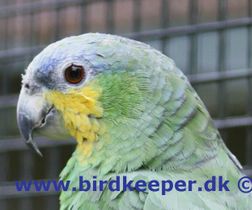
Mini portraits and articles - Parrot species from South America
Enjoy your reading!

Best regards,

Jørgen Petersen

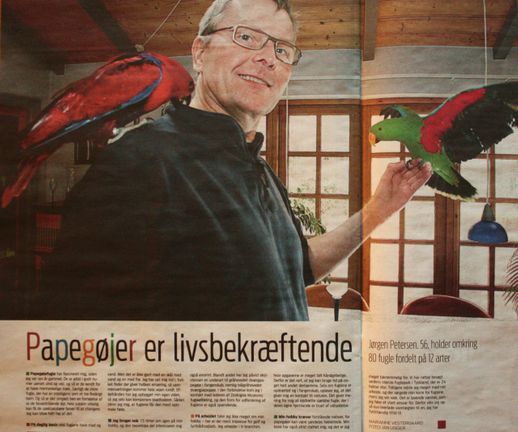
Editor & Owner of

www.birdkeeper.dk

and

Birdkeeper Parrot Breeding Facilities

Conceived/Updated: 23.12.2009 / 18.12.2025


IT IS NOT ALLOWED TO COPY PHOTOS OR TEXT FROM THIS SITE WITHOUT PRIOR WRITTEN ACCEPTANCE!

Call us during day timeE-mail usFind us